

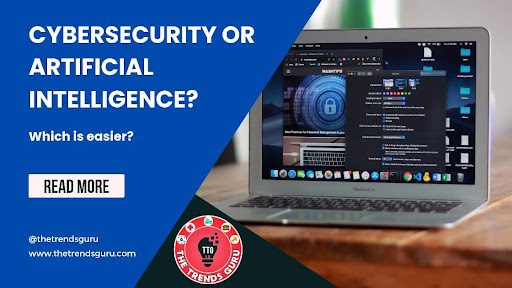
In an ever-changing global landscape of the tech industry, deciding on the best-fit profession can be difficult to navigate. Now, Which is Easy Cybersecurity or Artificial Intelligence? Cybersecurity and Artificial Intelligence (AI) are considered some of the top, highly demanded, and forward-thinking industries. Both of these areas are constantly developing, with vast career options.
But the burning question remains: Which is Easy, Cybersecurity or Artificial Intelligence? This guide breaks down comprehensively into both career paths to measure them in direct comparison, shedding light on the core skills, difficulty levels, and expected employment options of each discipline.
Hello There!
As innovations are ongoing to develop further at high speed, fields like Cybersecurity and Artificial Intelligence are gaining traction as key drivers in forming the digital realm. These industries are crucial to our everyday and career aspects, with organizations, authorities, and even users depending strongly on AI and cybersecurity technology systems.
If you are looking for a career in a tech-related profession, you may be asking yourself: Which profession is less difficult, and which one should you specialize in? Do you need to be a mathematical master to immerse yourself in AI, or can you start a career in cybersecurity without any prior experience in the computing field?
While both fields are highly rewarding and come with their challenges, the answer to this question is not straightforward. This detailed guide will help you weigh the pros and cons of each. And also compare their complexities, and ultimately help you decide which path is the right fit for you.
Let’s break down Cybersecurity and Artificial Intelligence in terms of:
- What each field involves
- Key skills and learning curves
- Job outlook and career paths
- The challenges you will face along the way
- Which field might feel easier depending on your strengths and preferences
What is Cybersecurity?

In its most straightforward version, Cybersecurity is the act of protecting computer systems, IT infrastructure, and stored records from hacking attempts, data stealing, and harm. Due to the rising frequency of digital threats such as hacking, email scams, harmful viruses, and data-locking malware, the need for qualified cyber defenders is more essential than ever.
Cybersecurity professionals work to prevent data breaches. They also secure sensitive information and maintain the overall safety of computer systems and networks. This can involve tasks such as:
- Identifying and mitigating vulnerabilities in systems
- Performing ethical hacking or penetration testing to find weaknesses
- Implementing security measures like firewalls and encryption
- Monitoring systems for potential threats and responding to incidents
- Remaining updated on the emerging patterns in digital threats and defensive systems.
The advantage of cyber defense is that it’s a direct engagement, action-oriented domain. It does not demand a Ph.D. in a math-heavy background to begin your career in cybersecurity. You just need a solid understanding of computer systems and the ability to resolve issues.
What is Artificial Intelligence/AI?
AI is a division of computing technology that concentrates on creating devices and machines designed to execute functions that would typically involve human-level cognition. These activities include comprehension, analytical thinking, action, and problem-solving.
In AI, machines are trained to recognize patterns, make predictions, and improve their performance over time without explicit programming. AI encompasses various subfields such as:
- Machine Learning: Teaching machines to recognize patterns in data and make decisions based on that data.
- Deep Learning: A subset of Machine Learning that uses neural networks to analyze large datasets.
- Natural Language Processing: Enabling machines to understand and process human language (such as chatbots or voice assistants).
- Robotics: Creating robots that can interact with the environment and perform tasks autonomously.
AI engineers typically work with extensive data collection, high-level algorithms, and math-based models to create independent systems. AI is transforming sectors from health services to the entertainment space, from driverless vehicles to custom suggestions on Netflix.
AI involves a robust foundation in mathematics, data analysis, and computer programming, notably for those interested in exploring predictive modeling and neural techniques.
Cybersecurity vs. AI: Key Differences
1. The Core Focus
Cybersecurity is primarily about prevention and protection. You’re focused on identifying vulnerabilities, preventing attacks, and responding to threats in real-time.
AI, on the other hand, is about creating intelligent systems that can think, learn, and adapt on their own. It’s about using data to make machines smarter and more capable of solving complex problems.
2. Nature of the Work
In cybersecurity, much of your work involves active monitoring, problem-solving under pressure, and staying one step ahead of cybercriminals. You’re constantly reacting to potential threats and taking action to mitigate risks. The focus is more tactical and reactive.
In AI, the work tends to be more strategic and long-term. You’re creating algorithms that can learn from data, and your job is to make these algorithms work as efficiently as possible. The focus is more on innovation and development.
3. Required Skills
Cybersecurity Skills:
- Knowledge of networking and firewalls
- Understanding of cryptography
- Proficiency with security tools (e.g., Wireshark, Kali Linux, Metasploit)
- Familiarity with programming languages like Python, C, or Java
- Problem-solving and critical thinking skills
AI Skills:
- Strong understanding of mathematics, particularly linear algebra, probability, and statistics
- Proficiency in programming languages like Python and R
- Familiarity with machine learning frameworks like TensorFlow and PyTorch
- Problem-solving and a deep interest in how algorithms can learn from data
4. Learning Curve
The learning curve for Cybersecurity can be gradual. You can start by learning basic concepts and build your way up with certifications and hands-on experience. It’s very much a skill-based field where you improve with practice.
On the other hand, AI can have a steeper learning curve. Especially if you are new to math-heavy subjects like calculus and statistics. AI requires a deeper theoretical understanding and often requires formal education.
5. Career Growth and Job Opportunities
Both fields are growing rapidly, but Cybersecurity is currently experiencing an explosive demand for professionals. It is due to the ever-increasing frequency and sophistication of cyber threats.
The U.S. Bureau of Labor Statistics (BLS) predicts 32% growth in cybersecurity job openings by 2032. AI is also booming, with a 23% job growth predicted over the next decade. AI experts are now required in almost every industry.
However, AI tends to offer higher salaries right from the start. It provides specialized roles like AI researchers or machine learning engineers commanding impressive paychecks. In contrast, cybersecurity professionals also enjoy lucrative salaries and strong career progression.
Cybersecurity: Pros and Cons
Pros:
- High demand: Cybersecurity roles are projected to grow at a rapid rate.
- Real-world experience: You can gain practical skills quickly through real-world scenarios.
- Diverse industries: Cybersecurity is needed in almost every industry, including government, healthcare, banking, and tech.
- Clear learning path: Certifications like CompTIA Security+, Certified Ethical Hacker (CEH), and CISSP provide structured routes into the field.
Cons:
- Stressful: The pressure to prevent breaches and respond quickly to threats can be intense.
- Constant learning: It requires staying up-to-date with ever-evolving threats.
- After-hours work: Some roles may require being on-call or working irregular hours.
Artificial Intelligence: Pros and Cons
Pros:
- Cutting-edge work: AI is at the forefront of technological advancements and offers opportunities to work on innovative projects.
- High salary potential: AI roles tend to offer higher salaries, especially in research and development.
- Wide applications: AI is used in many fields, from healthcare to finance. This makes it highly versatile.
- Creative problem-solving: If you love building intelligent systems and experimenting with new ideas, AI can be incredibly rewarding.
Cons:
- Complex learning path: AI requires a solid understanding of advanced math, programming, and algorithms.
- Theoretical work: Some AI roles can be heavily theoretical or research-based, which may not appeal to everyone.
- Limited entry points: AI roles often require specialized degrees or experience, making it harder for beginners to break into the field.
Which Career is Easier to Start?
Cybersecurity tends to be the easiest field to break into, particularly if you don’t have an advanced degree in computer science. With the right certifications and hands-on experience, you can enter cybersecurity relatively quickly. Many entry-level roles require practical skills more than academic credentials.
In contrast, AI typically requires a stronger educational background, such as a degree in computer science, data science, or engineering. Although it is possible to get started through online courses and self-study. The complexity of the field and the demand for specialized knowledge make it a longer journey.
Which One Pays Better?
Let’s talk salaries. Each profession comes with high-paying salaries in the U.S:
- Cybersecurity: As reported by Glassdoor and BLS, the standard compensation goes from $95,000 to $140,000. It is based on the job position and years of service.
- AI: AI experts bring in moderately greater income, typically reaching $110,000 to $160,000, in particular domains like complex AI training or machine-based technology.
However, foundational cybersecurity positions are potentially less complex to get into, even without higher education—indicating you could begin to earn right away.
Real-World Applications: Where You’ll See These Fields at Work
Cybersecurity in Action
- Blocking ransomware in hospitals
- Protecting user data in banks
- Securing cloud infrastructure for tech companies
- Preventing election interference
AI in Action
- Powering recommendation engines on Netflix
- Enabling self-driving car navigation
- Detecting fraud in real-time for credit card companies
- Diagnosing diseases in medical imaging
Industry Demand and Job Securing
Cybersecurity is often labeled as “recession-proof”. Why? Because every business needs to protect its data, regardless of the economy. While booming AI may be more vulnerable to shifts in tech budgets or project funding.
According to CyberSeek:
- There are 700,000+ unfilled cybersecurity roles in the U.S.
- Employers are desperate for trained professionals
In contrast, AI roles tend to be fewer but more specialized. You will find them in big tech, startups, and research-heavy institutions.
What Recruiters and Experts Say
Many tech recruiters say:
- Cybersecurity roles are more accessible but often require ongoing learning due to evolving threats.
- AI roles require a “builder’s mindset” and a strong technical foundation. Internships and projects help prove your skills.
Hiring managers also note that cybersecurity professionals are often hired faster. And, AI professionals undergo longer vetting processes due to the complexity of the role.
Conclusion
Finally, the final selection between Cybersecurity and Artificial Intelligence relies on your preferences, educational skill set, and career ambitions.
If you are interested in tackling challenges, administering connectivity setups, and remaining updated on the emerging cyber risks. Cybersecurity might feel like the better fit for you. It is hands-on, rewarding, and offers strong career prospects with a lower barrier to entry.
On the other hand, if you are excited by the potential to build intelligent machines and enjoy complex mathematical problems. Then AI could be the perfect fit. While it may have a steeper learning curve, the opportunities and rewards in AI are vast, and the field is growing at an impressive rate.
Both paths are highly rewarding and in demand. There is no bad pick. It’s about identifying where your skills and enthusiasm shine.
